Zabars: Recipe for Smoked Whitefish Toast with Radish Butter from Peas Love & Carrots by Danielle Renov

Recipe for Smoked Whitefish Toast with Radish Butter from Peas Love & Carrots by Danielle Renov

Original Article

450-Smoked-white-fish-toast-with-radish-butter

SMOKED WHITEFISH TOAST WITH RADISH BUTTER

I am almost as excited to write this blurb as I was to eat the dish. Basically, this dish was on my cookbook recipe list for months. Then after whittling and whittling the list down, it was sadly removed. Everyone agreed that no one would ever make it and I was just including it for myself. Which I was. But also, the space in the book became a thing and I finally gave in. Then something crazy happened. On the first day of our cookbook photo shoot, Eric, my cute, younger brother, brought brunch over for everyone. Being extra nice, he of course bought an entire smoked white fish. Literally the one staring at you in this photo. All day long everyone picked at it, because it was delicious, and at the end of the day it got wrapped up and put in the fridge. The next day, someone opened the fridge and said, Danielle do you have any recipes we can use this in, it would be so sad to waste it. I couldn’t believe my ears and screamed very loudly (which if you know me, you know what my excited scream sounds like, so picture that), that in fact, I had the perfect recipe for this leftover smoked white fish! And that, my friends, is why you are lucky enough to have my favorite brunch recipe ever. Hashem always sends us exactly what we need at exactly the right time!

INGREDIENTS:
1 long, crusty baguette, sliced in half lengthwise
1 cup butter
6-8 small red radishes, grated
¼ cup grated fresh red radish
½ tsp salt
¼ tsp coarsely ground black pepper
1 good quality smoked whitefish, flaked
¾ cup micro greens, to garnish

INSTRUCTIONS:
In a small bowl, combine butter, radish, salt and pepper.
Place baguette on a serving tray.
Spread inside of baguette with radish butter.
Add flaked whitefish to the baguette.
Top with micro greens; serve on a large platter with a serrated knife so everyone can help themselves to a piece and enjoy!

TIPS + TRICKS: If you don’t have a good crusty on the outside, chewy on the inside baguette to work with, you can lightly toast what you have to add that texture.

NOTE: Radish butter is also delicious as a dip for crudité. I know, dip vegetables in butter? That doesn’t sound right. Oh, but it is.

VARIATION: Replace smoked white fish with any variety of smoked fish or lox you like! You can even be wild and use herring!

Levana Cooks: Cookbook Review

Love Peas Carrots Cookbook. My Book Review

Love Peas Carrots Cookbook

Love peas and carrots cookbook

Order your copy soon before they all fly off the shelves!

I confess I chuckled to myself when I received the book and slightly flinched at its weight: somebody beside me actually had the temerity of writing a comparably massive book, which never fails to trigger joking comments laced with undisguised praise. (Something like, whoa, do we use it for cooking AND for weight lifting?). Being thrown back a whole decade in time felt so good! Yes, you gotta be a shtickle crazy to hunker down to a piece of work this size and caliber. But wait till you see it: it is nothing short of magnificent, worth all the time the author spent sequestered for the writing of her Magnum Opus.

I Am Breathless, But Hardly Surprised

With her book, Author Danielle Renov lives up to the promise of the wildly popular Blog she founded, with the deceptively naive name, Peas, Love Carrots, which earns her tens of thousands of adoring fans and counting. She may even inadvertently have created her own impossible act to follow: Orson Welles’s manager famously warned him, after the publishing of his monumental debut film Citizen Kane at age twenty five, to be prepared: he may well never be able to top himself. Hmmm, good problem so far. It doesn’t hurt one bit that Artscroll Publishers outdid themselves with this splendid production. And special thank you to Danielle’s talented Publicist Carrie Bachman for everything!

Peas Love Carrots Cookbook Makes No Apologies

It is a decidedly meat-centered book. It doesn’t pretend to be a cookbook that gives equal time to soups, salads, sides, fish, poultry, beef etc. No, it is not that kind of a well-behaved book. Rather, it conveys unabashedly that author Danielle Renov winks at a specific group: she knows what your inner bon vivant loves and doesn’t dare fully confess to loving (We’re officially cowering in fear of the Instafam Eat the Rainbow Plant Food Brigade, right?). The emphasis is overwhelmingly placed on the Fleishik part of our mostly secret  dining fantasies: yes yes yes, salads and soups and fish are mighty good for you and all that jazz, we know, and including them guarantees you lifelong good health and fitness. And yes they are all included. But this point is not the primary concern of the book. The book is in fact brimming with those roasts and ribs and chops and stews and cutlets whose recipes so often elude you and come out less than perfect. This is likely the only book you will need to use to make all these dishes foolproof: You’ll look like a pro. Needless to add, vegan diners need not apply: sorry, darling vegan friends, not this time!

The Author is Determined to Introduce Herself First

And this is what makes the author every bit as interesting as her work. She is a brand. All the more remarkable than Peas Love Carrots Cookbook is Danielle’s first foray into formal writing and publishing. She comes down like a gentle ton of bricks:

  • First and foremost, there is her extensive description of what food and cooking represents for her: much more than recipes well composed and well executed. A whole philosophy of life, a holistic way of life where food, hosting and thanking The Supreme Divine Source daily for all we own and all we are and all we do are inextricably intertwined. Nothing but blessings will follow for living our life in this supremely meaningful way. This fact alone presents a humble author who considers herself – and by extension urges us to consider ourselves – as but a small albeit vital part of the Grand Cosmic Equation.
  • She coaches the reader thoroughly, and whispers in her ear that if she follows her simple wisdom and her numerous tips, she practically can’t miss. 86 things, no less, she wants you to know about food and cooking. And she’s just getting warmed up! The initial pantry and condiment chapter is gorgeous; each item in a subgroup gathered in a collective picture that makes it as effective as if you took a mini crash course on familiar and essential staple topics: stocks; dressings; marinades; salatim; condiments; mayos.
  • She evidently has a plan and a method, but she never gets didactic: she is always in full charge, but is always guided by an infectious sense of humor that makes her and her recipes totally approachable and streamlined. Challah recipe: All you knead is love, haha, brilliant. None of her recipes uses any tricks or hacks. Nothing but the real thing. As significantly, she never caves in to social media’s tiresome fads and rules and tyrannies dictating what you should eat, how you should live, what you should deem important.
  • Each side of her bicultural Moroccan-Ashkenazi heritage is fully and authentically represented, each getting its full turn in the same sandbox. Nonono, don’t try any wisecracks about Ashkenazi food being insipid to the Sephardis, or about fiery Sephardi seasonings ripping those poor uninitiated Ashkenazi palates apart. All is equally good and delicious and vibrant and proudly representative of the respective culture it hails from. Go Morocco! Go Poland!
  • Her stunning photography. Like her philosophy of food, it borders on the mystical. It remains at all times narrowly focused on the philosophy of life and cooking she is determined to convey. The serene and spartan silver-bronze-steal minimalist color palette is as fascinating as it is rustic and timeless. Still life with dinner. And it is true of each single dish. The glowing chapter Fleishigs Magazine recently devoted to the book’s food stylist Frances Boswell and photographer Moshe Wulliger at the studio caused as much anticipation and excitement as sneaking backstage and visiting a theater set.

Peas Love Carrots Cookbook Desserts

Several recipes in this chapter look too much like my little Fanny’s Arts and Crafts projects. It is short and predictable. But it is the only weak link in this gigantic essential book, so I gladly give her a dessert pass. PS don’t worry, Sfenj and Biscotti are there!

Hatzlacha!

Dear Danielle, take your beautiful book everywhere, make it part of every kitchen, print and reprint! Oh yeah, next edition, please include number of servings in each recipe.

Peas Love Carrots Cookbook: Two Fav Recipes!

Brisket pomegranate sauce. Peas Love Carrots Cookbook

Brisket Pomegranate Braised Brisket

1 (3-3.5 lb/11⁄2 kg) 2nd cut brisket

RUB

  • 3 Tbsp sugar
  • 1 Tbsp kosher salt
  • 1 Tbsp sumac
  • 1 Tbsp ground mustard powder
  • 1 Tbsp paprika
  • 1 Tbsp garlic powder
  • 1 tsp cracked black pepper
  • 1 tsp cayenne pepper

MEAT

  • 2 Tbsp canola oil
  • 3 medium onions, halved and sliced
  • 1 tsp kosher salt
  • 1 tsp coarsely ground black pepper
  • 3 cloves garlic, smashed
  • 1 (11 oz/330 ml) bottle
  • hard apple cider 1⁄2 cup tomato sauce (not marinara)
  • 1⁄2 cup pomegranate molasses (syrup)
  • 2 cups beef stock (or 1 beef bouillon cube dissolved in 2 cups hot water)
  • to garnish (optional)
  • 1⁄4 cup pomegranate seeds

In a bowl, combine all rub ingredients.

Rinse brisket and pat dry very well.
Rub the spice mixture all over both sides of the brisket.
(The spice rub makes more than you will probably need. Freeze the rest for another brisket.)
Place spiced brisket into a ziptop bag; refrigerate overnight.
(If you’re short on time, just let spiced meat come to room temp for 1 hour. Then continue with the recipe.)

Remove from the fridge; allow brisket to come to room temperature. Preheat oven to 350°F / 180°C.

Heat a large Dutch oven or ovenproof pan over high heat.
Add oil and brisket.
Sear both sides of the meat for 4-5 minutes per side until nicely browned. Remove from Dutch oven; set aside.

To the same pot, add onions, salt, and pepper.
Cook for 4 minutes until onions are soft and translucent. Add garlic; cook for 1 minute.

Add hard cider, using a wooden spoon to stir it in and scrape up any browned bits from the bottom of the pan.

Add remaining ingredients.
Bring mixture to a boil; return brisket to the Dutch oven.
If you used a pan, pour the sauce and onions over the brisket.

Cover the pot tightly. Bake for about 11⁄2 hours.

Remove from oven; turn brisket over. Return to oven.
At this point, cooking time will vary based on the size of your meat. I suggest giving it another 45 minutes, no matter the size, and after that checking it every 30 minutes until it is soft and tender.
Mine took 3 hours total for a 4 pound brisket.

Remove from the oven and allow brisket to cool completely in the sauce. (Taking the brisket out of the sauce while it is hot will result in a dry brisket.)

If you want to shred the brisket, wait 45 minutes after you take it out of the oven and, while it is still warm, use 2 forks to shred it in the pot, where it can stay in the liquid.

To slice brisket, allow it to cool completely, then remove from sauce and slice against the grain. Garnish with pomegranate seeds, optional.

Savory Stovetop Turkey

  • 1 large whole deboned turkey breast
  • 1 Tbsp kosher salt
  • 1 tsp coarsely ground black pepper
  • 1 1⁄2 tsp granulated garlic
  • 1 1⁄2 tsp paprika
  • 1 Tbsp neutral oil
  • 1 onion, thinly sliced
  • 4 cloves garlic, minced
  • 2 Tbsp tomato paste
  • 1 1⁄2 cups dry white wine
  • 2 bay leaves
  • 1 Tbsp white vinegar
  • 2 cups chicken broth
  • 1⁄4 cup duck sauce

In a small bowl, combine salt, pepper, garlic, and paprika. Season turkey breast with mixture on all sides.

Heat a pot over medium heat. Add oil; place turkey top side down and sear for 4 minutes on each side.
Remove turkey from pot; set aside.

Add onion; cook for 12 minutes.�Add garlic and tomato paste to the pot. Cook for 2 minutes until fragrant.�Add wine, bay leaves, and vinegar, stirring to scrape up any bits on the bottom of the pan.
Cook for 2 minutes; add chicken broth and duck sauce.�Return turkey to the pot, spooning some of the mixture over the top.
Bring mixture to a boil, cover pot, and reduce heat to low. Cook for 11⁄2 hours, basting every 20 minutes or so.
Serve hot and enjoy.

Tip: If making in advance, slice turkey when it’s cold, return to sauce, and reheat gently.

Hatzlacha!

Dear Danielle, take your beautiful book everywhere, make it part of every kitchen, print and reprint! Oh yeah, next edition, please include number of servings in each recipe.

The Jewish Link: It’s Hard Not to Love ‘Peas Love & Carrots’

It’s Hard Not to Love ‘Peas Love & Carrots’

Original Article

There are a few things you need to know about “peas love & carrots, the cookbook.”

The first is that “peas love & carrots” is the brainchild of Jerusalem resident Danielle Renov who, with her children fast asleep and her husband out of town, decided to dip her toes into the seemingly endless waters of Instagram one fateful night approximately five years ago. Taking on a name that had just popped into her head, Renov decided to share a personal stash of original recipes on social media and the rest, as they say, is history. When Instagram debuted its stories feature a short time later, Renov was quick to hop on board doing demos, building relationships and amassing an impressively large base of fans who found her to be both likable and relatable.

Which brings us to the second thing you need to know about “peas love & carrots.” Yes, this is a cookbook with more than 250 recipes, but “peas love & carrots” is so much more than just a collection of appetizing recipes and gorgeous pictures. Peppered with generous servings of humor and a full commentary on every dish, reading this book is like chilling with a close friend, one who gets you and understands what real life is all about. That sense of approachability and feeling of connection are the secret behind Renov’s popularity and the many anecdotes, tidbits and, of course, cooking tips in the cookbook are filled with heart, which is what “peas love & carrots” is all about.

Last but not least in my unofficial intro to Renov’s labor of love (with a side of peas and carrots, of course) is that this is as much a book about cooking as it is a cookbook. Think of “peas love & carrots” as Cooking 101 at your local community college, with kitchen newbies gently ushered into a new world with clear, step-by-step instructions. Renov’s “86 things I want you to know about this book + cooking in general” is full of practical advice such as putting on comfortable shoes when you cook and understanding the difference between kosher and table salt. Sticking to the “keeping it real” format that has earned her more than 62,600 Instagram followers, Renov discusses her fondness for cloth napkins and kitchen timers while making clear her aversion to celery strings and raisins, which she describes as the unfulfilled potential of grapes, adding, “They could have been wine. Now they are ruining noodle kugel for children everywhere.”

Ironically, while Renov had been amassing original recipes that gave voice to both her Ashkenazic and Sephardic roots for years, she never intended to publish a cookbook. But life has a way of just happening, and in her introduction, Renov explains that “peas love & carrots” was created as a thank you to both God and her followers. Clearly the demand for Renov to compile her recipes was there because the cookbook sold 42,000 copies in just four weeks, its first printing of 18,000 books selling out completely before they could even be delivered to ArtScroll’s warehouse.

I know it sounds cliché, but there really is something for everyone in “peas love & carrots,” with recipes ranging from easy weeknight dinners to more elaborate spreads for Shabbos or Yom Tov and everything in between. Renov starts with the basics, listing an impressive repertoire of homemade mayonnaises and a wide range of dips including pistachio olive and sesame-free almond techina. She goes big with a full-page recipe for sautéed onions that calls for 40 onions that slow cook for hours, correctly pointing out that just about everything tastes better with the addition of well-browned onions. Salads and dressings play a significant role in “peas love & carrots,” some amped up with proteins such as fish, chicken or cheese, while others feature just veggies in all their glory.

My favorites here? The sheet-pan pizza that lets you mix things up so that everyone gets their favorite slice without having to take out multiple cookie sheets, the baked hoisin-sriracha chicken egg rolls, made with leftover chicken and, because I love all things chocolate, especially when paired with flakes of Maldon salt, the dark-chocolate almond joy truffles. Don’t forget to check out some of Renov’s truly inspired creations including the tomato soup with cheddar cheese matzah balls (yes, you read that right), bar-b-cumin’d carrots with a touch of lime and the bourbon-braised short rib recipe that works equally well on full-sized roasts and is laced with a full 12 ounces of bourbon. I also have to give a special shout out to the no-boil, no-dishes corned beef that I tried out two weeks ago on a piece of meat that I was worried might have a little bit of a boingy texture, something that isn’t exactly a plus in a main dish. It came out perfectly textured and my reservations about using a full three tablespoons of dry mustard on the meat rapidly disappeared as everyone at the table devoured the corned beef. Learn from my mistakes and be super careful when you remove the meat from the foil, or you will end up with a saucy mess all over your kitchen counters that really isn’t all that much fun to clean up.

Be sure to take note of Moshe Wulliger’s stunning photographs and Renov’s chapter headings offering plays on words such as “an apron is just a capon backwards” before the poultry section and “they lived apple-y ever after” preceding the desserts. “peas love & carrots” will keep you smiling as you slice, dice and sauté your way through its 432 pages, its French Moroccan, Eastern European, Israeli and American flavors reflecting Renov’s heritage as well as her Five Towns upbringing and her current Israeli existence, offering a trip around the world, through time and into its author’s heart.


Sandy Eller is a freelance writer who writes for numerous websites, newspapers, magazines and private clients. She can be contacted at sandyeller1@gmail.com.

The Takeout: To make an unforgettable salad, add haloumi croutons

To make an unforgettable salad, add haloumi croutons

Original Article

Haloumi and Sweet Potato Salad with Blueberry Vinaigrette
Photo: Moshe Wulliger

In her first cookbook, Peas, Love and Carrots, author Danielle Renov (of the popular blog of the same name) says that in Israel, where she lives, this salad is so popular that it can be found in just about every Kosher dairy restaurant. Now that I know this exists, I’m pretty upset that we here in America have willingly accepted half-assed Caesars as our unofficial national salad, when we could be eating a whole-assed salad like this one. Why settle for stale croutons when we could be having cubes of fried cheese?


Haloumi and Sweet Potato Salad with Blueberry Vinaigrette

Reprinted from Peas, Love and Carrots: The Cookbook (2020) with permissionfrom ArtScroll Mesorah Publications

For the dressing:

  • ½ cup dried blueberries
  • ¼ cup balsamic vinegar
  • ¼ cup apple cider vinegar
  • 1 shallot, finely diced
  • 1 tsp Dijon mustard
  • 1 tsp pure maple syrup
  • 1 tsp kosher salt
  • 1 tsp coarse black pepper
  • ¾ cup extra virgin olive oil

For the salad:

  • 2 large sweet potatoes (about 2.2 lb/1 kilo total), peeled and cut into ¼-inch-thick sticks
  • 1 tsp kosher salt
  • ½ tsp coarse black pepper
  • 1 Tbsp + 1 tsp extra virgin olive oil, divided
  • 3 cups baby spinach
  • 3 cups arugula
  • 1 red onion, halved and thinly sliced
  • 1 (1lb/400g) block haloumi cheese, cut into ½ inch cubes

Combine blueberries and vinegars in a bowl or jar. Using a spoon, smush blueberries a bit to help them open up and release their flavor into the vinegars. Add remaining dressing ingredients to the bowl or jar; whisk well or shake to combine. Refrigerate until 15 minutes before you want to dress your salad.

The Nosher: Potato Chip Schnitzel Recipe

Potato Chip Schnitzel Recipe

Crispy and indulgent.

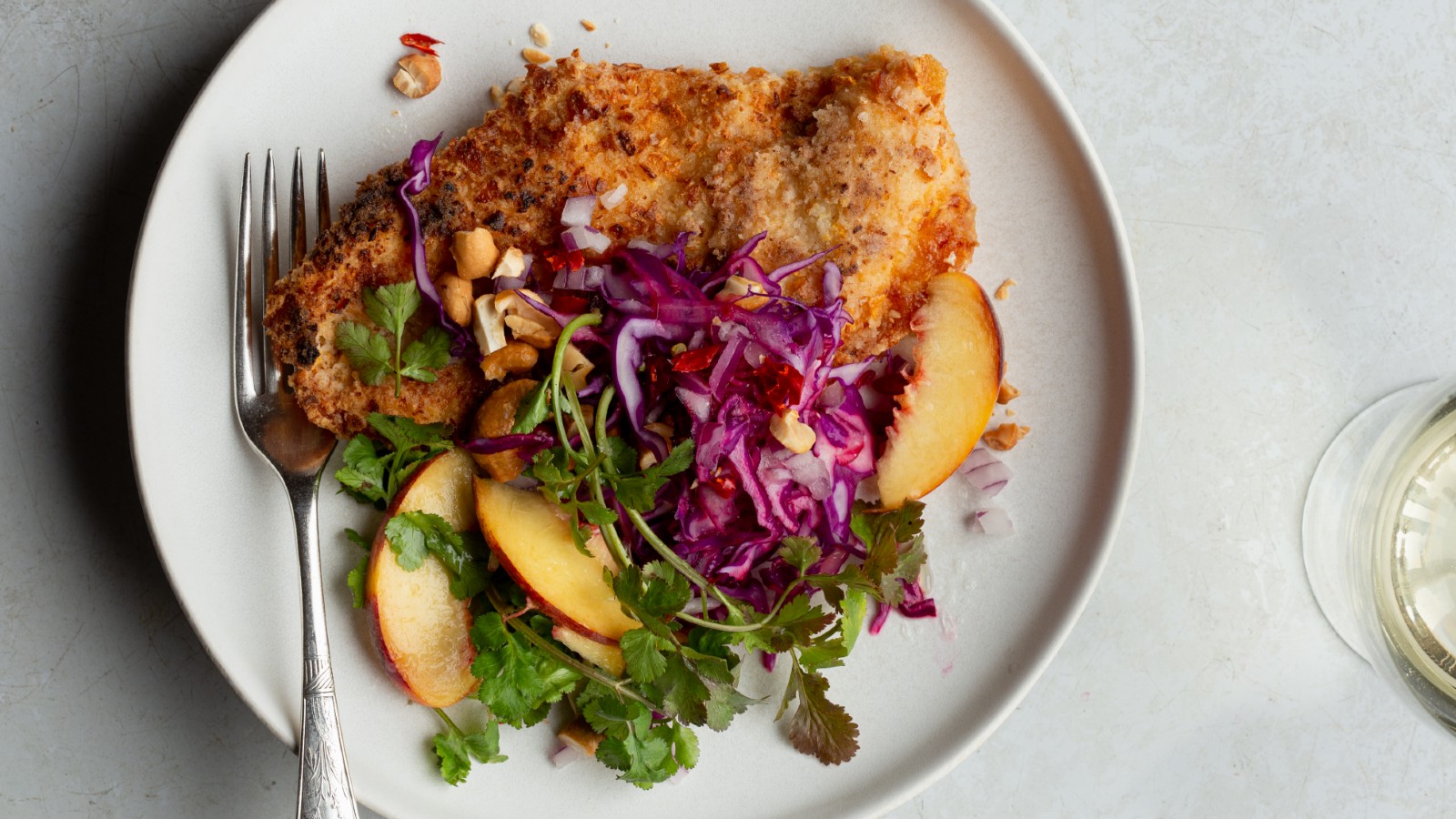
This is, to a few members of my family, the best version of schnitzel. If it weren’t for the fact that the crumbs were made of deep-fried potatoes, I would make this all year long. I love the idea of a cold, crunchy salad over a hot, juicy, right-out-of-the-oven piece of schnitzel, but you can easily separate this recipe’s components and serve them on their own. I promise, they are that good! 

Excerpted from Peas Love and Carrots by Danielle Renov. Copyright 2020 by ArtScroll Mesorah Publications, photos by Moshe Wulliger. Reproduced with permission of the copyright holder. All rights reserved.

Ingredients

For the chicken: 

  • 12 thin chicken cutlets 
  • 4 cups potato chip crumbs (salty potato chips crushed by hand or in a food processor until they resemble fine breadcrumbs) 
  • 3 cups potato chips gently crushed by hand (they should look like broken potato chips, not crumbs) 
  • 2 cups potato starch 
  • 3 eggs, beaten 
  • 1 Tbsp garlic powder 
  • 1 tsp black coarsely ground black pepper 
  • 1⁄4 tsp kosher salt
  • oil, for frying 

For the slaw: 

  • 4 nectarines or peaches (slightly firm), halved and thinly sliced 
  • 3 cups shredded purple cabbage
  • 1 purple onion, diced 
  • 1 cup roasted, salted cashews, roughly chopped 
  • 1⁄2 cup lime juice
  • 3 Tbsp sugar 
  • 1-2 Thai chilies, finely chopped, or any small, spicy red pepper (optional)
  • 1⁄2 cup cilantro leaves, finely chopped 
  • 1 tsp kosher salt 
  • 1⁄4 tsp coarsely ground black pepper 

Directions

  1. In a large bowl, combine all potato chips and potato starch.
  2. In a second bowl, combine eggs, garlic powder, pepper, and salt. 
  3. Dip each cutlet in egg mixture and then into potato chip mixture, using your hands to help press the potato chips onto the chicken. 
  4. Heat 1-2 inches of oil in a frying pan.
  5. When oil is hot, add 2-3 pieces of schnitzel to the pan. It is important not to overcrowd the pan or the schnitzel will steam and not get crunchy! Fry for 2-3 minutes on the first side and then flip and fry for 1-2 minutes on the second side.
  6. Transfer from pan to a cooling rack to allow any excess oil to drip off. 
  7. To make the slaw, in a large bowl, toss together sliced peaches, cabbage, onion, and cashews.
  8. In a small bowl or jar with a tightly fitting lid, combine remaining ingredients. Mix or shake well to dissolve the sugar.
  9. Toss with slaw; marinate for 4-5 minutes. 
  10. To serve, place 1⁄4 cup slaw over each piece of schnitzel. 

Danielle on KATU2 TV

“Peas, Love & Carrots” Author Danielle Renov

Original Link

Cookbook author and recipe developer Danielle Renov joined us all the way from Israel to teach us the many ways to braid challah. Her challah recipe is in the new cookbook “Peas, Love & Carrots”. You’ll find the recipe below too, along with a variety of delicious dip recipes.

For more delicious inspiration from Danielle, follow her on Instagram and check out her website.

challah recipe

My challah recipe is 14 years in the making. i started with one recipe when i was 18 and tweaked it and tweaked it until i achieved a dough that was light and fluffy and, most importantly, adaptable. add in a little more honey, no problem. want to go with savory toppings, sure. maybe something indulgent like stuffing it with chocolate chips and a sweet crumb topping, go for it! the dough is versatile and easy to work with. and that, my friends, is why i chose to begin this book, probably the most important professional task i’ve taken on thus far, with this recipe. challah, one of the three mitzvos granted specifically to women, is an extremely holy and beautiful commandment. it can easily feel daunting and intimidating. i get it. so i created this recipe to overcome that: to help make it approachable, doable, and, most of all, to make it a mitzvah that we are blessed to be able to do just a little bit more accessible!

makes 6 medium or 4 large challahs

  • 3 heaping Tbsp dry yeast
  • 34 cup sugar
  • 4 cups warm water
  • 1 cup oil
  • 2 eggs
  • 34-1 cup sugar (depending on how
  • sweet you want your challah to be)
  • 2 Tbsp honey (optional)
  • 1 Tbsp vanilla (trust me)
  • 1 (5 lb) bag flour (or 2 (1 kg) bags + 34 cup flour)
  • 2 Tbsp kosher salt
  • 1 egg + 2 yolks, lightly beaten

In a very large bowl, combine yeast, sugar, and warm water. Set aside to allow yeast to bloom for 8 minutes.

Meanwhile, in a second bowl, combine oil, eggs, sugar, honey (if using), and vanilla.

Mix well.

When yeast mixture is very bubbly, pour in oil mixture; stir to combine. Add a little less than half the flour to the bowl.

Using a spoon, mix the flour into the liquid very well.

Mix for 2-3 minutes to help the gluten start to develop.

Add salt; mix till incorporated.

Reserve 1 cup flour in case the dough will be too sticky; add the remaining flour. (Remember, you can always add flour but you can’t take it out!)

Mix with a spoon until it becomes too difficult to stir.

Pour dough out onto your work surface. No need to flour the surface. Knead for 10 minutes, working in more flour as needed.

Once dough is smooth and elastic, place back into the bowl.

Pour a little bit of oil into your hand and rub all over the dough.

Place a piece of plastic wrap directly on dough; cover the bowl with a towel.

Allow to rise until it has at least doubled in size.

Remove plastic wrap and punch down the dough.

Replace plastic wrap and let dough rise again. (You can repeat this step as many times as you need until you are ready to braid the dough.)

Divide dough into 4-6 sections, depending on how many and what size challahs you would like to make.

Cut each section into 4-6 parts; roll each into a strand. Alternatively, wind each section around itself to form round challahs.

Braid the strands, place onto a baking sheet or into baking pans, and cover with a towel.

Let challahs rise for 45 minutes to an hour. (Don’t skip this step.)

Preheat oven to 350F / 180C. (For round challahs, heat oven temperature to 340F / 175C.)

Brush each challah with beaten egg; add toppings as you like.

Bake for 25-45 minutes until challahs are deeply golden and baked through. Remove pans from the oven; allow challahs to cool for 5 minutes.

Transfer challahs to a cooling rack; cool completely.

I like to wrap my challahs individually in foil.

If I make them on Friday, I leave out what I need for Shabbos, but if I make them on another day, even Thursday, I freeze them.

to thaw:

Remove from freezer a few hours before serving.

Place wrapped challah on the plata (hot plate) or in the oven to reheat with the rest of your food.

Serve warm and enjoy!

tips + tricks

Use a 4 cup measuring cup that is also marked with a 34 cup measurement. After you pour in the water, measure your oil and add the rest of your ingredients to the cup. No need to dirty another utensil!

The more you knead the dough, the smoother and more elastic it will become. Be patient. If, after 7 or 8 minutes of kneading, the dough feels very dry or too sticky, add a bit more water or flour.

To prevent dough from drying out, make sure it is completely covered with the plastic wrap.

I like to let my dough rise a few times, which results in a fluffier challah. Let it rise completely, punch it down, and then let it rise again. Do this at least once, and up to three or four times!

Topping Ideas

Egg wash and a sprinkle of sugar.

Egg wash and minced garlic, parsley, and chili flakes.

Egg wash and everything spice.

Roasted garlic, or garlic confit on the bottom. (Place roasted garlic cloves into a greased challah pan, top with formed challah; brush with egg wash and sprinkle with salt and paprika. Bake as usual. The garlic bakes into the bottom of the dough and it is heavenly!)

Egg wash followed by crumb topping: In a bowl, combine 2 cups flour, 112 cups sugar, 14 tsp kosher salt, 18 tsp cinnamon, and scant 12 cup canola oil to form crumbs. If it’s too dry, add oil, little by little, until desired texture is reached.

For my favorite challah ever, place 1 cup golden saute?ed onions (page 22) and 1 cup lightly golden saute?ed garlic into a greased and parchment lined challah pan (don’t drain off the oil; add that into the pan also!). Place braided uncooked challah onto onions and garlic. Rise, egg, and bake as usual. Serve hot and enjoy!

Credit line: Excerpted from Peas Love and Carrots by Danielle Renov. Copyright 2020 by ArtScroll Mesorah Publications, photos by Moshe Wulliger. Reproduced with permission of the copyright holder. All rights reserved.

chimmi-schug-pesto

Place jalapen?os and garlic into the bowl of a food processor fitted with the “S” blade. Blend till finely minced.

Add herbs, lemon juice, and salt.

With food processor running, drizzle in oil.

Taste to adjust seasoning.

Transfer to an airtight container; store in the fridge for up to 10 days!

  • 1-3 jalapen?o peppers (depending how spicy you like it)
  • 7 cloves garlic
  • 1 cup cilantro leaves
  • 112 cups parsley leaves
  • juice of 12 lemon
  • 12 tsp kosher salt
  • 14 cup + 2 Tbsp extra virgin olive oi

simply schug

Place garlic into the bowl of a food processor fitted with the “S” blade; use a few pulses to mince.

Add roughly chopped jalapen?os and bell pepper (if using). Process for 1 minute, pausing to scrape down the sides a few times.

Add salt and lemon juice, pulsing once or twice to incorporate.

Store in an airtight container for up to 2 weeks and eat with every single thing you consume!

for israel

  • 10 cloves garlic, roughly chopped
  • 15 long spicy green peppers, roughly chopped
  • 12 tsp kosher salt
  • 2 tsp fresh lemon juice
  • for everywhere else in the world, where jalapen?os are short & stubby
  • 8 cloves garlic, roughly chopped
  • 18 jalapen?o peppers, roughly chopped
  • 12 green bell pepper, roughly chopped
  • 12 tsp kosher salt
  • 2 tsp lemon juice

Moroccan schug

Place green pepper and garlic into the bowl of a food processor fitted with the “S” blade; process until minced.

Add cilantro, parsley, mint, paprika in oil, and salt.

Pulse until very finely minced. You may have to scrape down the sides of the bowl a few times.

With the processor running, drizzle in vinegar and lemon juice.

Turn off food processor; use a spoon to mix in the oil.

Transfer schug to an airtight jar; store in the fridge for up to 3 weeks. Serve hot and enjoy!

  • 1 long spicy green pepper
  • 4 cloves garlic
  • 112 cups cilantro leaves
  • 34 cup parsley leaves
  • 2 mint leaves
  • 2 tsp paprika in oil
  • 12 tsp kosher salt
  • 1 Tbsp vinegar
  • 1 Tbsp fresh lemon juice
  • 3 Tbsp extra virgin olive oil

techina

In a blender or food processor fitted with the “S” blade, blend garlic with lemon juice. Add tahini, salt, and pepper. Blend again until combined.

Depending on how thick or thin you want your techina to be, while blender is on, slowly drizzle in water until you reach the desired consistency. (You may need to adjust the seasoning, so taste!)

Refrigerate until serving.

  • 3 cloves garlic
  • juice of 1 lemon OR 2 small limes
  • 12 cup tahini paste
  • 2 tsp kosher salt
  • 1 tsp coarsely ground black pepper
  • 114 cups very cold water as needed

tips + tricks

For the creamiest techina, shake the tahini paste bottle very well before pouring and make sure to use very cold water!

Forward: Danielle Renov’s new cookbook celebrates Sephardic and Askenazic food—just not raisins

Danielle Renov’s new cookbook celebrates Sephardic and Askenazic food—just not raisins

Danielle Renov by the Forward
Image by Moshe Wulliger

Danielle Renov

There are 86 things Jerusalem-based, Long Island-born food blogger Danielle Renov wants you to know about her new kosher cookbook, “Peas Love & Carrots” — and about cooking in general. She lists them across two pages right up front, and like the book itself the list is highly practical and deeply personal — a combination Cooking 101 and Intro to the Author.

There’s basic kitchen wisdom: “Write the date on anything that goes in your freezer.” There’s girlfriend guidance: “Turmeric will stain your hands. And nail polish. Wear gloves.”

And there’s the distinctively idiosyncratic: “Raisins are the unfulfilled potential of grapes. They could have been wine. Now they are ruining noodle kugel for children everywhere.”

Raisins, it seems, are an issue for Renov — so much so that they reappear in the last of the 86 things where she writes, “This is a banana, raisin, and marinara free book. Just so you know.”

Apparently, some who saw the manuscript prior to publication worried about the raisins.

“So many people ask me about number 86 of the 86 things,” Renov said recently. They were afraid it might alienate readers. “I was trying to make a point: I like all the food in this book. I don’t like raisins. There’s nothing in there with raisins because how could I give you a recipe that I don’t want to eat? The book is really authentic to who I am. I would say I only knew how to write it one way, and that was with me in it.”

Peas Love and Carrots by the Forward
Image by Moshe Wulliger

Renov grew up on Long Island, the child of a Conservative New York-born Ashkenazi father and a Sephardic Moroccan mother from Casablanca who was raised in Paris before moving to the Five Towns, a thriving Jewish community on the South Shore of Long Island. Once married, Revov said, her mother cooked the best from both cultures, learning to make kugel and pot roast and “grill steak like a champion.”

“What it taught us in terms of food is there are no limits,” Renov said. “You can bring different cultures into your life and eat everything. My parents had an appreciation for all types of food and passed that onto us. And I moved to Israel and its identity is really mixed up and a mushkabobble of different food cultures. I’ve been here for 13 years and that culture has seeped into my culture.”

The resulting recipes represent a vibrant, cross-cultural amalgamation of foodways. They reflect Renov’s Moroccan and Ashkenaz background and the wide variety of culinary and cultural influences she found in Israel — Palestinian, Lebanese, Turkish, Syrian, and more. “And who doesn’t love a good Mexican fish?” she asks. “So it’s a mixture of everything that I love. I couldn’t put myself in a box because I don’t live in a box.”

Indeed from cover to cover, “Peas Love & Carrots” is a reflection of its author. Voice-driven and breezy, the book is filled with tips and guidance in addition to some 250 highly approachable recipes — and it expresses Renov’s deeply held values surrounding family, faith, and sustainability. Food, for her, is a way of connecting all three.

“From a Jewish perspective, I believe God gave us this beautiful earth and it’s not ours to trash,” she said. “We were given this world and we have to leave it to future generations, and every generation takes its toll on the earth more and more and it’s simply unfair. There are ways to eat and live off this planet without destroying it. Here in Israel we’re on this tiny land, smaller than New Jersey, and if we don’t sustain this land then what will our children have?”

Toward that end, Renov recommends eating seasonally and locally and supporting local farmers and vendors — hard to avoid in Israel, but often an afterthought in many other places. “Even though I knew in New York that things tasted better at different times of the year, they were still accessible,” she said. “If I had to have a strawberry in February, I could go buy a strawberry.”

Soon after moving to Israel, she planned to make a dessert that involved strawberries and spent hours searching for them. It was summer, so it didn’t occur to her that they would be unavailable. “So I’m looking and looking — where the heck are the strawberries,” she said. “So I walk into a local fruit and vegetable store and he literally laughed in my face like I was a crazy person.”

In Israel, he explained, strawberry season is in January, so you eat strawberries in January.

“I learned that instead of making a menu and then going shopping, I need to go shopping before I make a menu,” Renov said. She went back to the store with a notebook and asked the shopkeeper to tell her all about the seasons, which he did.

In addition to learning to shop seasonally, Renov quickly learned to support local farmers and vendors. Whereas her American family had shopped the American way, buying everything at one big supermarket, when she moved to Israel there were only little shops and the sprawling open-air markets known as shuks. Renov learned that you go to the meat vendor for meat and the fishmonger for fish. You go to the herb guy for herbs and the watermelon guy for watermelon.

“They get first dibs on the best products,” she said, explaining that because they’re only dealing in one thing, the grower is going to go to those vendors first because they’re selling more than anyone else.

“You get better-quality food and better-quality ingredients, and you’re supporting people who have been doing this for literally a hundred years,” she said. “There are vendors in the shuk who’ve inherited their stalls from their great grandparents — most of the stalls in the shuk are inherited. Especially now, with everything going on in the world, we have an obligation to sustain our local vendors, to sustain each other.”

Tuna salad a la moi by the Forward

Image by Moshe Wulliger

Tuna salad a la moi

All that local produce is featured prominently in “Peas Love & Carrots,” which has a vibrant section devoted to salads and another to vegetable-focused sides. The salad chapter kicks off with a dazzling photo of a dozen colorful dressings (there’s an image associated with every recipe in the book) followed by pages of salatim —the small plates of salad which, along with dips and spreads, form the Middle Eastern mezze. According to Renov, “No Shabbos meal can begin in our home without an assortment of these salatim.”

One of Renov’s favorites is the grain-based farro and cherry tomato salad, which she calls her Shemittah salad because she moved to Israel in a Shemittah(or Shmita) year, when farmers take a break from harvesting or planting their fields.

“Grain salads became my best friend, because somehow we never run out of grains (or tomatoes),” she writes in the recipe headnote. Another favorite is her tuna salad a la moi, which is bright with shredded purple cabbage and radicchio along with a variety of other vegetables and a scattering of chopped preserved lemon — a definite departure from regular tuna.

Renov’s grilled chicken panzanella is a hearty take on the typical Italian bread salad. “If I’m going to go through the effort to start grilling bread,” she writes, “I’m going to add some chicken on to that grill and make this a whole meal, or at least a significant part of a beautiful Shabbos meal!”

Danielle Renov by the Forward
Image by Moshe Wulliger

Danielle Renov

Every dish in this user-friendly cookbook is easy to find. Following the salads are chapters devoted to soup, fish, poultry, meat, sides, dairy and sweets. There’s also a “foundations” section that includes recipes for challah, preserves, pickles, and dips. There are two separate recipe indexes, one at the front that’s organized by chapter and another at the back that’s alphabetical.

So which dishes are most significant to Renov?

“I think the recipes that are the most meaningful to me are less about the food itself than the memory it creates for me,” she responded. “The same way a song or a smell can transport you back, food does that to me. I think the foods that are very significant to me throughout my life, most of them are the Moroccan recipes.” There’s fifle tomatese, which she describes as a basic Moroccan stew, usually made with leftover chicken. “We ate that at least once a week growing up, and I serve it now to my kids,” she said. “As a kid it wasn’t significant to me, but as an adult it became significant to me.”

Another is a dish called mufletta that’s traditionally served at Mimouna, the celebration that follows Passover. “It’s the most delicious thing, but it’s so tedious to make,” Renov said. “Whenever I asked my grandmother for it she always made it for me, and it’s one of my favorite things in the world. Publishers give you a page limit, and even though I didn’t think it was a recipe that many people would make, for me it had to be in the book.”

Of course it did. Because for Renov, “Peas Love & Carrots” is nothing if not personal.

A former food editor of the Forward, Liza Schoenfein is author of the blog Life, Death & Dinner. Follow her on Instagram @LifeDeathDinner.

Splendid Table: Confetti Pepper Chicken

Original Article

When I was first married, my mother gave me a recipe from her close friend, Naomi, to make for shabbos. It was a version of this chicken that I tweaked and tweaked over the years to create this easy but flavorful chicken. What I really love about this dish is that it’s a cooked chicken that you can reheat or serve at room temperature for shabbos lunch because it is not saucy!

 Ingredients:

  • 12 chicken cutlets

  • 1 cup flour (I use spelt)

  • 2 tsp kosher salt, divided

  • 2 tsp coarsely ground black pepper, divided

  • 3 Tbsp oil, divided

  • 4 bell peppers (1 red, 1 yellow, 1 orange, 1 green), cut into 1/2 inch dice

  • 1 onion, diced

  • 4 cloves garlic, minced

  • 1/2 cup sherry or white wine

  • 1 1/4 cups chicken stock

 Directions:

Heat oven to 350°F.  Coat a baking dish with nonstick cooking spray.

In a large bowl, combine flour, 1 teaspoon salt, and 1 teaspoon pepper.

Dip each cutlet into flour, shaking off excess.

Heat a large pan over medium heat.

Add 2 teaspoons oil; working in batches, brown chicken on both sides for 1 minute. Don’t cook through. Add oil as needed for each batch.

Transfer chicken to prepared baking dish. Set aside.

Once all the chicken has browned, add remaining oil to the pan along with peppers, onion, remaining teaspoon salt, and remaining teaspoon pepper. Cook, stirring, for about 10 minutes, until pepper and onions have softened and released their juices.

Add garlic; stir for 1 more minute.

Add wine; simmer for 4 minutes. Stir in chicken stock.

Pour all the veg and pan juices over the chicken in the baking dish. Bake about 35 minutes until the edges of the peppers slightly char.

Serve hot and enjoy.

Excerpted from Peas Love and Carrots by Danielle Renov. Copyright 2020 by ArtScroll Mesorah Publications, photos by Moshe Wulliger. Reproduced with permission of the copyright holder. All rights reserved.


Each week, The Splendid Table brings you stories that expand your world view, inspire you to try something new, and show how food brings us together. We rely on you to do this. You have the power to keep us cooking, sharing these stories, and helping you in the kitchen.

AJC Cookbook review: Melting-pot meals from an Israeli kitchen

Cookbook review: Melting-pot meals from an Israeli kitchen

AJC BOOKS FOR HOME COOKS | Aug 19, 2020

Review: “Peas, Love, and Carrots: The Cookbook” by Danielle Renov (ArtScroll Mesorah Publications, $39.99)

For those who’ve never visited Danielle Renov’s popular blog, Peas, Love and Carrots, or are not yet one of her 60,000-plus Instagram followers, the first recipe in her new cookbook speaks volumes. It’s for challah, a recipe she started working with when she was 18, and has been tweaking ever since to make the dough as versatile and approachable as possible. She supplies tips for achieving maximum fluffiness, topping ideas both savory and sweet, and instructions for freezing and thawing.

Just as importantly, she explains, is its significance to her as one of the three mitzvos (blessings) granted specifically to women. She understands why making challah can feel daunting to a novice baker, “and so I created this recipe to overcome that.”

Half Moroccan and half Ashkenaz, Renov grew up on Long Island and moved to Israel with her husband soon after they married. She started her blog to share her values of health, family and friends, and faith by way of her kitchen.

“Peas, Love, & Carrots: The Cookbook” (ArtScroll Mesorah Publications, $39.99) is a weighty and gorgeously designed testament to her heritage and “what brings my children to the table today.” Besides challah, she offers many other recipes suitable for Rosh Hashanah (Sept. 18-20) and other Jewish occasions. But mostly, she focuses on modern, everyday family fare with global flavors accessible to all. Asian Chicken Crumble Salad — seasoned ground chicken quickly stir-fried and served atop a soy sauce-seasoned salad of bok choy and other vegetables — made a delicious low-carb meal in record time.

From the 16-quart pot of chicken soup she makes every week to the popcorn granola loaded with broken up candy bars and honey-roasted peanuts tossed together on a moment’s notice, Renov’s recipes are designed to “make the diners feel like they have been given a warm hug.” Who couldn’t use more of that?

EVENT PREVIEW

Danielle Renov at MJCCA Virtual Book Festival. 1 p.m. Sept. 9. Renov will demonstrate how to make Moroccan Matzah Ball Soup and do a Q&A with host Holly Firfir in a Zoom webinar as part of the Marcus Jewish Community Center of Atlanta’s virtual book festival. Tickets are $6. Register at atlantajcc.org/bookfestival.

Susan Puckett is a cookbook author and former food editor of The Atlanta Journal-Constitution. Follow her at susanpuckett.com.